Research Abstract & Thesis
Standard quantum mechanics textbooks almost exclusively treat tunneling through rectangular barriers due to their analytical solvability. This computational investigation demonstrates that barrier geometry introduces dramatic differences in transmission: under identical peak height (V₀ = 5.0) and width (W = 5.0), an exponential profile transmits approximately 2.3 × 10⁶ times more than a rectangular barrier. Using a pure Python finite-difference solver validated to sub-0.04% error against analytical benchmarks, we evaluate five geometries, define the WKB Shape Factor (S), and model diverse bound-state and scattering phenomena.
Publication Figures (Generated via Matplotlib)
Direct high-resolution figures from the formal paper exploring convergence, bound states, and scattering dynamics.
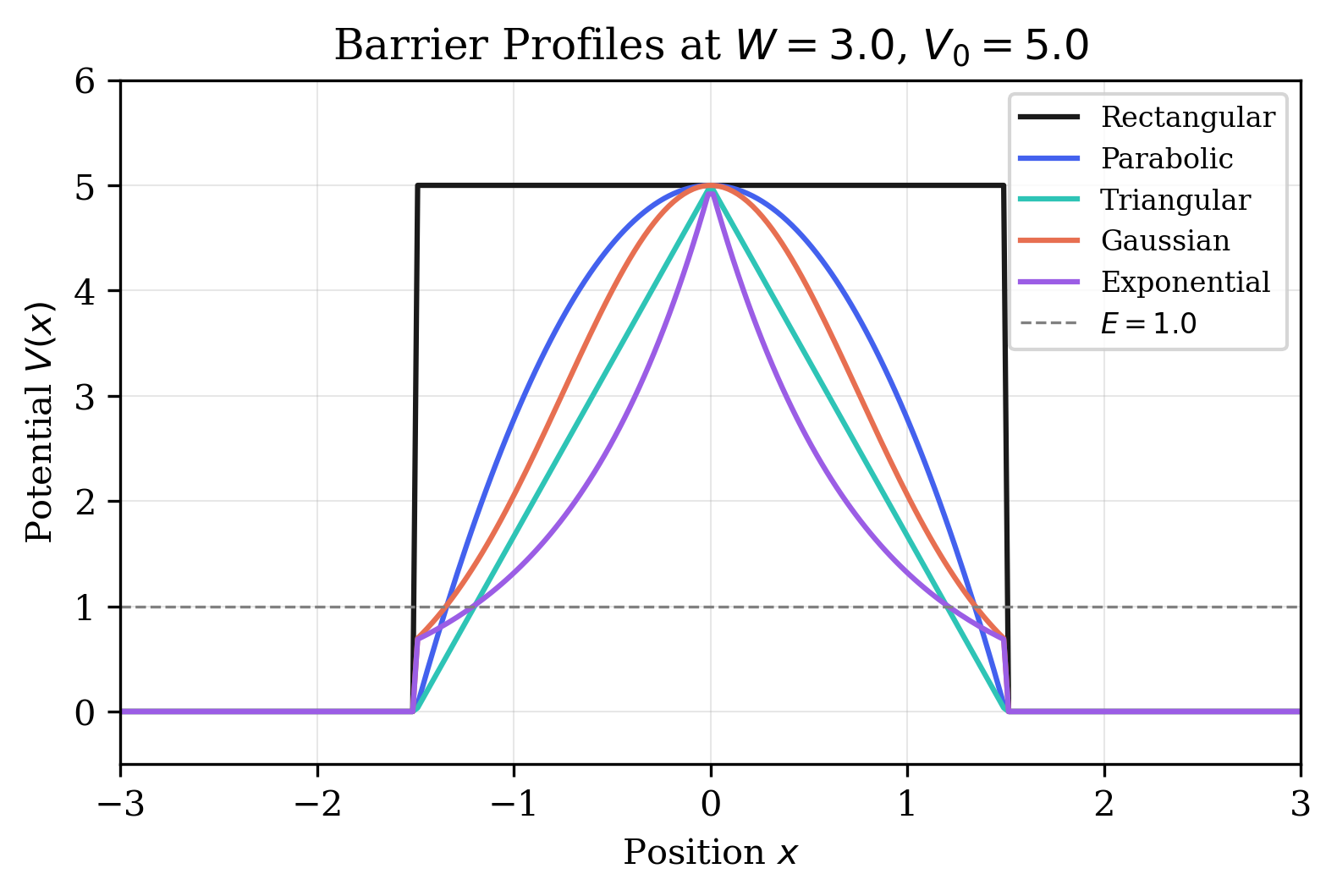
1. Barrier Profiles Overlay
The five barrier geometries (Rectangular, Parabolic, Triangular, Gaussian, Exponential) evaluated under fixed width W=3.0 and height V₀=5.0 with particle energy E=1.0.
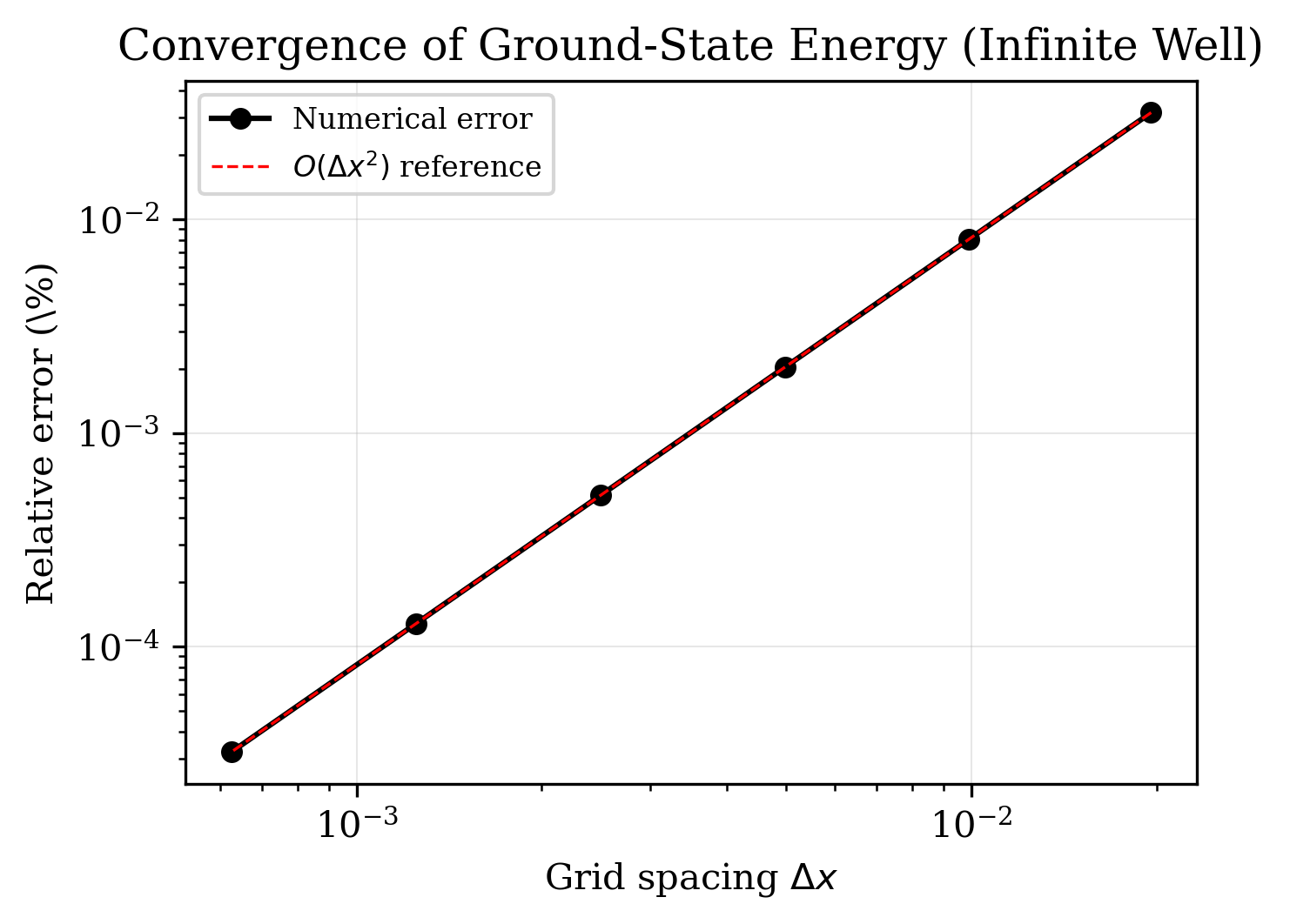
2. Numerical Convergence Analysis
Log-log plot of relative eigenvalue error versus grid spacing Δx for the infinite well ground state, confirming exact O(Δx²) second-order convergence.
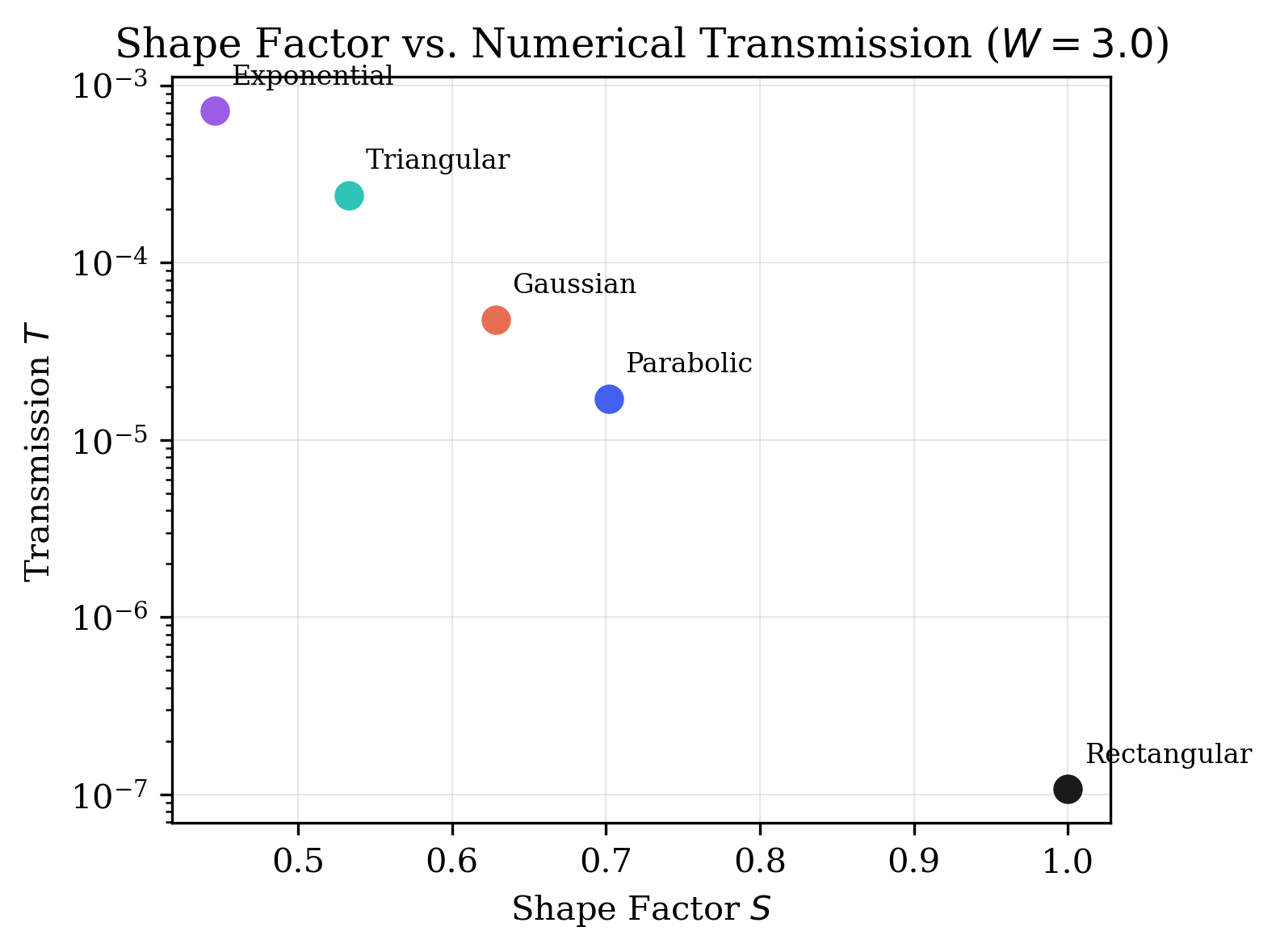
3. Shape Factor Correlation
Empirical correlation between the WKB-derived Shape Factor S and exact numerical transmission T at W=3.0 on a logarithmic scale.
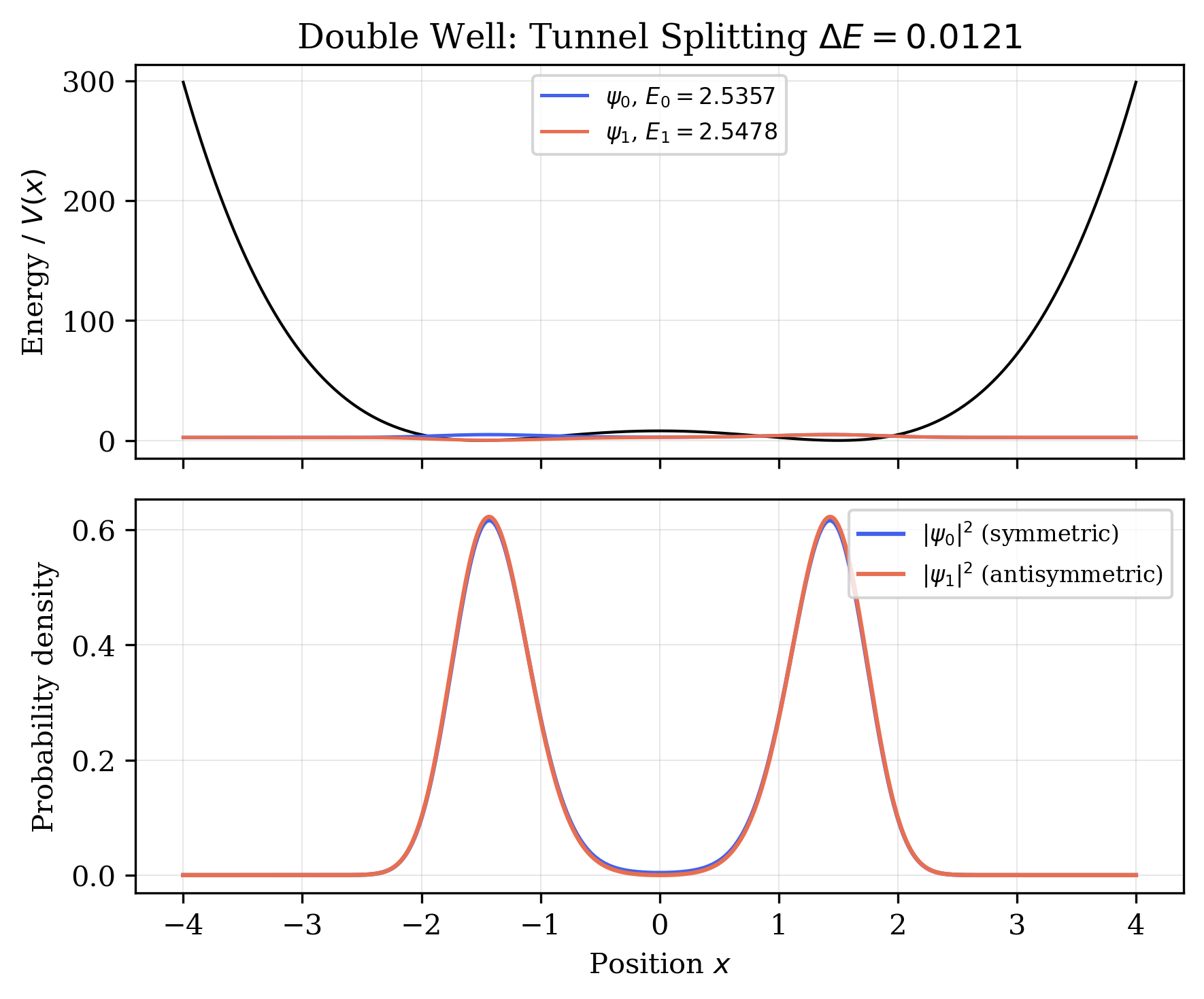
4. Double-Well Tunnel Splitting
Symmetric ground state (ψ₀) and antisymmetric first excited state (ψ₁) in a double-well potential, showing the energy level splitting ΔE.
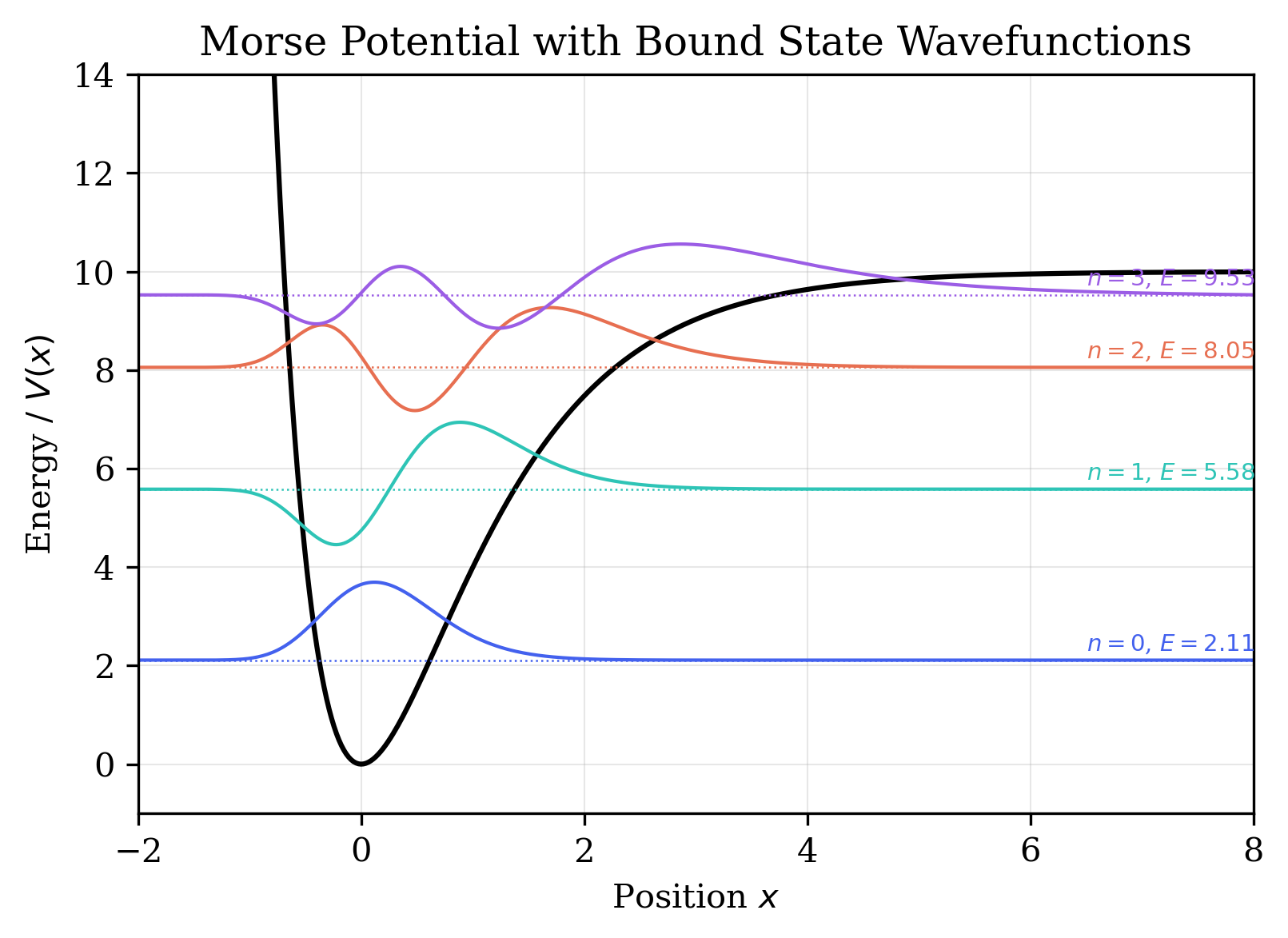
5. Morse Potential Anharmonic Vibrations
Calculated molecular vibrational wavefunctions offset by their eigenvalues. Decreasing level spacing illustrates impending molecular dissociation.
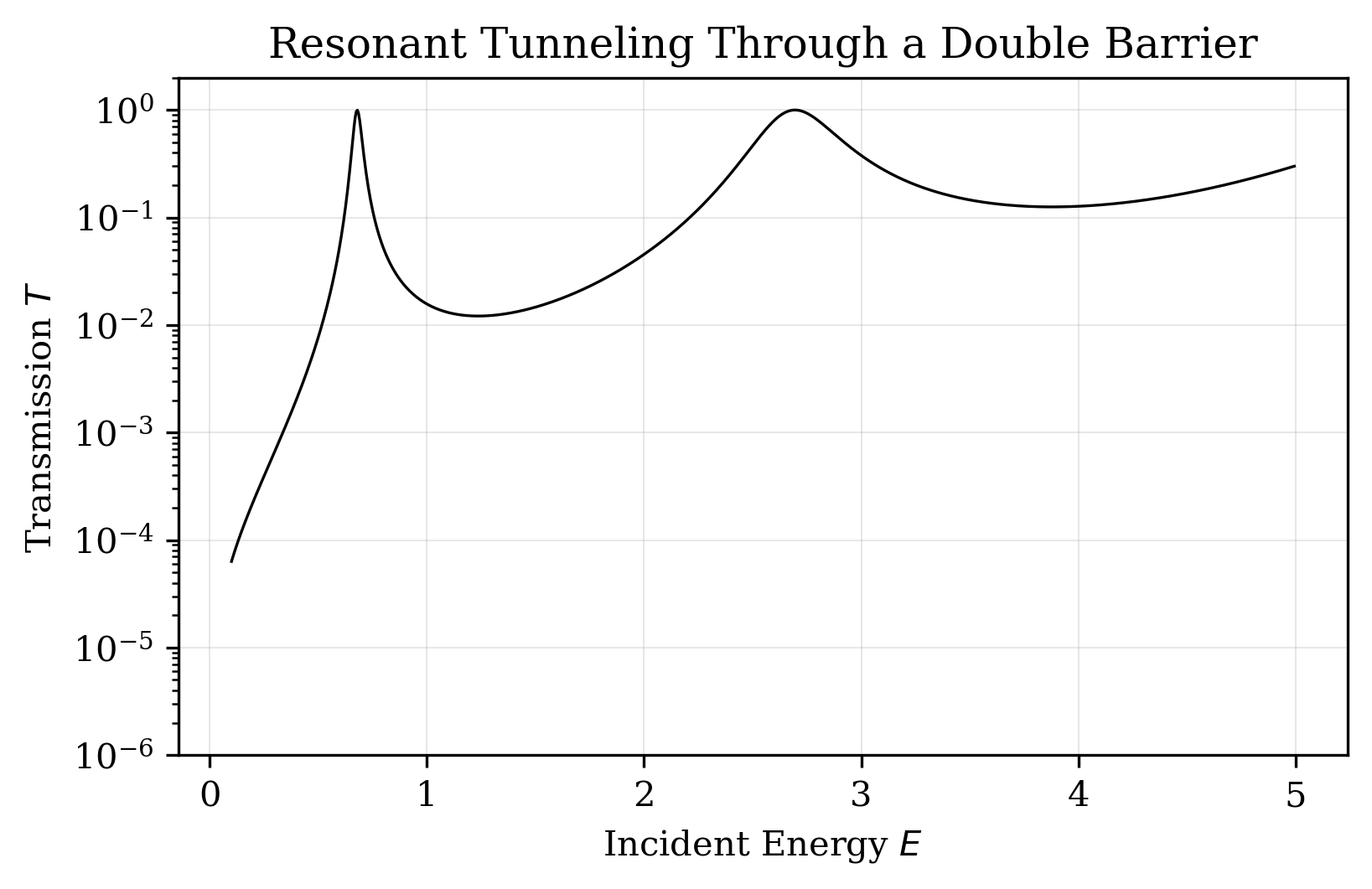
6. Resonant Cavity Transmission
Transmission spectrum T(E) across a double-barrier structure showing sharp Fabry-Pérot resonant transmission peaks approaching unity.
Interactive WKB Barrier Explorer
Interactive Geometry Profiles
Dynamically updates potential curves and incident energy level as sliders adjust.
WKB Shape Factor Comparison
Calculated geometric correction coefficients relative to a rectangular barrier (S = 1.000).
Calculated Transmission Probabilities
| Rank | Shape | Transmission Probability (T) | Relative to Rectangular |
|---|
Numerical Parameter Sweeps
Logarithmic Transmission vs. Barrier Width
Numerical transmission probability (T) across width W ∈ [0.5, 5.0]. Exponential slope differences reflect distinct integrated barrier areas.
Double Barrier Resonant Transmission
Transfer matrix sweep showing sharp transmission resonance (T ≈ 1.0) due to constructive quantum interference inside the cavity.
Time-Dependent Wave Packet Dynamics
Crank-Nicolson Wave Packet Collision
Time-dependent Schrödinger equation integration. A Gaussian wave packet bifurcates continuously into simultaneously propagating transmitted and reflected packets upon colliding with a potential barrier.